


Correct bra size after breast surgery
Following aesthetic or medical breast surgery, a post-operative bra is often worn during rehabilitation. With a strong focus on material, function, and design, a post-operative bra is intended to promote better healing, for which compression and support are crucial.
To ensure that a post-operative bra is comfortable and provides the lift and support you need, it is very important to wear the correct size. It is therefore worth taking your time and measuring carefully when choosing your size, both for a post-operative bra and your regular bra. In fact, most women wear the wrong bra size. Many simply continue wearing the same size as before and assume that a poor fit is due to an unusual or atypical bust, which is rarely the case.
To prevent your bra from chafing, pinching, pulling or causing discomfort, it is important to measure correctly. However, even a correctly measured bra is not guaranteed to fit perfectly. You may need to try different sizes or styles before finding the right fit.
A bra has two size measurements: a number and a letter. The number is determined by the measurement around your body directly under the bust and indicates the band size (e.g. 75). The measurement around the fullest part of your bust is converted into a letter indicating the cup size (e.g. B). Your bra size combines the band size and cup size (e.g. 75B).
Before you start measuring, put on an unpadded bra and have a measuring tape ready. If you are measuring yourself, standing in front of a mirror can help. Alternatively, you can ask a friend to measure you. The band size is the most important measurement, so always measure your underbust circumference first. This measurement is then used as the basis for determining your cup size. Many people think that the cup size indicates the size of the bust, but it actually reflects the difference between the underbust and bust measurements. A C cup is therefore different in sizes 70C and 90C. Similarly, the cups in sizes 80A and 75B are the same size. These are known as sister sizes, which are explained in more detail below.
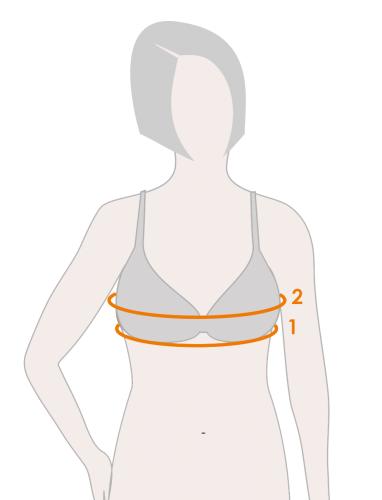
Underbust measurement (1)
Start by measuring tightly around your bare skin, directly under the bust. Make sure the measuring tape is level all the way around, then pull it snugly. This is your band measurement. Round to the nearest number ending in 0 or 5 (e.g. 77 cm = 75).
Bust measurement (2)
Measure around your body again, this time at the fullest part of your bust, usually at nipple level. Do not pull the tape tight; let it rest loosely but evenly against your bra. Round the bust measurement (e.g. 90.3 cm) to the nearest whole number (e.g. 90). For a more precise bust measurement, you can instead measure from the centre of your spine to the centre of your breastbone and multiply that measurement by two.
Cup size
To determine your cup size, subtract your underbust measurement from your bust measurement (e.g. 90 - 75 = 15). The result determines your cup size according to the table below (e.g. 15 = B).
Cup size
12-14 = A
14-16 = B
16-18 = C
18-20 = D
20-22 = E
22-24 = F
24-26 = G
26-28 = H
28-31 = I
Bra size
Your final bra size is the band size combined with the cup size (e.g. 75B).
Sister sizes
If the bra in your calculated size does not fit perfectly, you can try a bra in a so-called sister size. If the cups fit well but the band is too loose, go down one band size. To maintain the correct cup volume, go up one cup size (e.g. 75B = 70C). If the band feels too tight, you should instead go up a band size and down a cup size (e.g. 80A).
Sister sizes (each row has the same cup volume)
65A
70A = 65B
75A = 70B = 65C
80A = 75B = 70C = 65D
85A = 80B = 75C = 70D = 65E
85B = 80C = 75D = 70E = 65F
90B = 85C = 80D = 75E = 70F = 65G
90C = 85D = 80E = 75F = 70G = 65H
95C = 90D = 85E = 70F = 70G = 70I
How to check that your bra fits correctly
- The bra should sit at the same height at the front and back.
- The band should not ride up at the back. If it does, the band is probably too large or the shoulder straps are too short.
- You should be able to fit your fingers just inside the band.
- Your breasts should not spill out of the cups, creating a “double breast” effect. If they do, the cups are usually too small.
- There should be no bulging near the armpits, as this may indicate that the cups are too small.
- Your breasts should not be visible below the bottom edge of the bra, as this may indicate that the cups are too small.
- If the bra has underwires, they should sit directly underneath the breasts.
- There should be no gaps in the cups, as this indicates that they are too large.
- The shoulder straps should not dig into your skin, as this puts too much weight on your shoulders. Try loosening the straps.
- The shoulder straps should not slip off or sit too far out on your shoulders. Tighten them, checking the adjustment regularly, or try a smaller band size.
- Make sure the shoulder straps only keep the cups in place. The band should provide the lift and support for your bust.
- If the cups crease or wrinkle, they are probably too large.
- The band should not dig into your back or sides. If it does, it is too small.
- The cups should fit comfortably and fully enclose your breasts.
- Make sure the bra fits well on both sides.
- Check that the bra stays in place when you raise your arms. If it moves, the band may be too large.
- A new bra should fit well on the loosest hook setting, allowing you to tighten it as the band stretches over time.
- Remember that your body is likely to change over time, so measure yourself regularly.
Explore our range of bras and breast bands after breast surgery or prosthesis bras.
If you need help choosing the right size or style of bra, please contact our customer service team on +46 42 35 22 20 or email info@nordicare.se.


