


Clinical studies show: A postoperative binder contributes to pain relief
Recovering from abdominal surgery often involves both physical and psychological challenges. Whether it's related to a caesarean section, hernia, or stoma, pain, reduced mobility, wounds, or incisional hernias are common after the operation.
We have compiled a number of clinical studies showing that an abdominal binder can reduce pain, increase mobility, and decrease the risk of postoperative complications. Both immediately after surgery and during the rehabilitation phase. The use of binders after surgery has been evaluated in several systematic meta-analyses, which are based on randomized controlled trials (RCTs).

Abdominal binders after different types of abdominal surgery
Using a binder after abdominal surgery can provide both physical and psychological support during recovery. Studies show that a binder can reduce pain, provide increased security, and promote mobilization, which in turn could lead to shorter hospital stays, lower healthcare costs, and a better quality of life. Studies show that patients undergoing laparotomy and using an individually fitted, prefabricated binder postoperatively have significantly reduced pain compared to patients without a binder. In one of the studies, NordiCare's binder "LyftPlus" was used.
Benefits according to meta-analyses1,2:
• Reduces postoperative pain, especially 1-4 days after surgery.
• Facilitates mobility and mobilization, especially on day 3.
• Reduces the risk of complications.
• Lower morphine dosage is needed (in laparotomy).
• Provides an increased sense of security and stability.
1. The efficacy of abdominal binder in women undergoing cesarean delivery: A meta-analysis of randomized controlled trials. 2. Evidence on postoperative abdominal binding: A systematic review with meta-analysis of randomized controlled trials. 3. The Clinical Effects of Abdominal Binder on Abdominal Surgery: A Meta-analysis.
Binder after hernia surgery
During surgery for, for example, a ventral hernia, a binder is used to reduce pain and facilitate healing. The binder can also reduce the feeling of discomfort and the risk of recurrence by preventing overexertion.
Benefits according to a 2024 meta-analysis1,2:
• Reduced pain 2 weeks after surgery.
• Improved mobilization and walking ability (6MWT).
• Reduces the feeling of heaviness or discomfort.
• Lower incidence of surgical site infection (SSI).
Binder for stoma and parastomal hernia
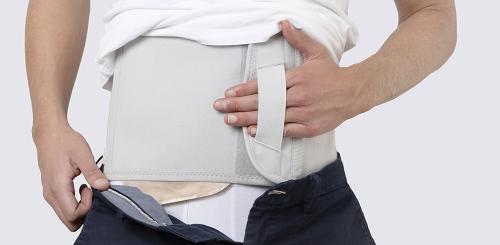
For people with a stoma, a binder can provide support and prevent herniation. For the binder's function in preventing parastomal hernias, there are 3 evidence-based guidelines. The results highlight the importance of the stoma nurse's work to achieve good outcomes. Fitting, need, information, and assessment are important pieces.
Benefits according to 3 evidence-based guidelines1-5:
• Can prevent the development of a parastomal hernia
• Provides pain relief for an existing hernia
• Increases security during movement and physical activity
• Improves body image and self-confidence
1. Parastomal Hernia Prevention, Assessment, and Management: Canadian Best Practice Recommendations. 2. Supporting Adults Who Anticipate or Live with an Ostomy 3. Prevention and treatment of parastomal hernia: a position statement on behalf of the Association of Coloproctology of Great Britain and Ireland.

Binder after caesarean section
In recent years, several studies have been conducted evaluating the use of binders specifically after caesarean sections. They show a clear effect on reduced postoperative pain, which also positively impacts breastfeeding. Furthermore, increased postoperative mobilization is seen, which in itself can reduce the risk of complications. Research shows that many women experience improved function, relief, and quality of life when using a binder in the first few days after a caesarean section.
Benefits according to meta-analyses (2021-2024)1,2:
• Effective pain relief for up to 48 hours postoperatively.
• Increased mobilization within 24 hours.
• Positive effect on breastfeeding.
• Reduced postoperative stress.
• Increased quality of life and sense of control.
1. The efficacy of abdominal binder in women undergoing cesarean delivery: A meta-analysis of randomized controlled trials. 2. The efficacy of abdominal binders in reducing postoperative pain and distress after cesarean delivery: A meta-analysis of randomized controlled trials. 3. The effectiveness of the abdominal binder in relieving pain after cesarean delivery: A systematic review and meta-analysis of randomized controlled trials.
Pain level reduced in patients using a binder
The chart below shows the pain level in patients before and after surgery. The grey bars show the pain level in patients without a binder and the orange bars show the pain level where patients used a binder. After surgery, the bars show that the pain level is higher in patients without a binder.
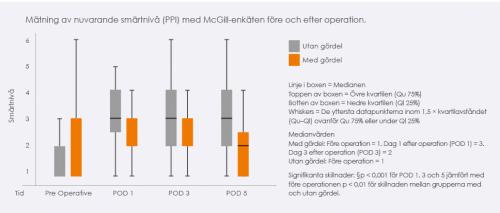
Source: The effect of abdominal support on functional outcomes in patients following major abdominal surgery: a randomized controlled trial.
Reference List
• Parastomal Hernia Prevention, Assessment, and Management: Canadian Best Practice Recommendations. • Supporting Adults Who Anticipate or Live with an Ostomy | RNAO.ca. • ACPGBI Parastomal Hernia Group. Prevention and treatment of parastomal hernia: a position statement on behalf of the Association of Coloproctology of Great Britain and Ireland. Colorectal Dis. Off. J. Assoc. Coloproctology G. B. Irel. 20 Suppl 2, 5–19 (2018). • Abd-ElGawad, M. et al. The effectiveness of the abdominal binder in relieving pain after cesarean delivery: A systematic review and meta-analysis of randomized controlled trials. Int. J. Gynaecol. Obstet. Off. Organ Int. Fed. Gynaecol. Obstet. 154, 7–16 (2021). • Abeles, A., Kwasnicki, R. M., Pettengell, C., Murphy, J. & Darzi, A. The relationship between physical activity and post-operative length of hospital stay: A systematic review. Int. J. Surg. Lond. Engl. 44, 295–302 (2017). •Borglit, T., Krogsgaard, M., Theisen, S. Z. & Juel Rothmann, M. Assessment of a support garment in parastomal bulging from a patient perspective: a qualitative study. Int. J. Qual. Stud. Health Well-Being 17, 2039428 (2022). • Chantawong, N. & Charoenkwan, K. Effect of Elastic Abdominal Binder on Pain and Functional Recovery Following Gynecologic Cancer Surgery: A Randomized Controlled Trial. Medicina (Mex.) 57, 481 (2021). • Cheifetz, O., Lucy, S. D., Overend, T. J. & Crowe, J. The effect of abdominal support on functional outcomes in patients following major abdominal surgery: a randomized controlled trial. Physiother. Can. Physiother. Can. 62, 242–253 (2010). • Christoffersen, M. W., Olsen, B. H., Rosenberg, J. & Bisgaard, T. Randomized clinical trial on the postoperative use of an abdominal binder after laparoscopic umbilical and epigastric hernia repair. Hernia J. Hernias Abdom. Wall Surg. 19, 147–153 (2015). • Clay, L., Gunnarsson, U., Franklin, K. A. & Strigård, K. Effect of an elastic girdle on lung function, intra-abdominal pressure, and pain after midline laparotomy: a randomized controlled trial. Int. J. Colorectal Dis. 29, 715–721 (2014). • Di Mascio, D. et al. The efficacy of abdominal binders in reducing postoperative pain and distress after cesarean delivery: A meta-analysis of randomized controlled trials. Eur. J. Obstet. Gynecol. Reprod. Biol. 262, 73–79 (2021). • Gouin, J.-P. & Kiecolt-Glaser, J. K. The impact of psychological stress on wound healing: methods and mechanisms. Immunol. Allergy Clin. North Am. 31, 81–93 (2011). • Graziani E Sousa, A. et al. Effect of an abdominal binder on postoperative outcomes after ventral hernia repair: a systematic review and meta-analysis of randomized controlled trials. Hernia J. Hernias Abdom. Wall Surg. 29, 20 (2024). • Hoskins, C., Dempsey, A. & Brou, L. A Mixed-Methods Study of the Effect of Abdominal Binders on Opioid Use and Postoperative Pain After Cesarean Birth. Nurs. Womens Health 26, 30–37 (2022). • Hubbard, G. et al. Experiences of support garments following bowel stoma formation: analysis of free-text responses in a cross-sectional survey. BMJ Open Gastroenterol. 6, e000291 (2019). • Jiang, N. et al. The Clinical Effects of Abdominal Binder on Abdominal Surgery: A Meta-analysis. Surg. Innov. 28, 94–102 (2021). • Lin, S.-L., Yen, C.-F., Hsieh, C.-J., Chang, W.-P. & Wang, C.-H. The efficacy of abdominal binder in women undergoing cesarean delivery: A meta-analysis of randomized controlled trials. Midwifery 142, 104281 (2025). • Melzack, R. The short-form McGill Pain Questionnaire. Pain 30, 191–197 (1987). • North, J. Early intervention, parastomal hernia and quality of life: a research study. Br. J. Nurs. Mark Allen Publ. 23, S14-18 (2014). • Ossola, P., Mascioli, F., Coletta, D., Pizzato, M. & Bononi, M. Evidence on postoperative abdominal binding: A systematic review with meta-analysis of randomized controlled trials. Surg. J. R. Coll. Surg. Edinb. Irel. 19, 244–251 (2021). • Rothman, J. P., Gunnarsson, U. & Bisgaard, T. Abdominal binders may reduce pain and improve physical function after major abdominal surgery - a systematic review. Dan. Med. J. 61, A4941 (2014). •Saeed, S. et al. Use of Abdominal Binders after a Major Abdominal Surgery: A Randomized Controlled Trial. Cureus 11, e5832. • Strigård, K., Stark, B., Bogren, A. & Gunnarsson, U. Ventral hernia and patient experience of an elastic girdle. ANZ J. Surg. 85, 525–528 (2015). • Taylor, C. et al. Experiences of wearing support garments by people living with a urostomy. Br. J. Nurs. Mark Allen Publ. 28, S26–S33 (2019).
• Melzack, R. (1987). The short-form McGill Pain Questionnaire. *Pain, 30*(2), 191-197.


